Most cold emails fail before the prospect even considers the offer.
The initial subject line is weak, the opening sounds automated, or the sender quits after a single attempt. But the absolute most common failure point in B2B sales is the cold email follow up.
If you send one email and quit, you are wasting your leads. If you send five emails that all say "just bubbling this to the top of your inbox," you are burning your domain reputation.
Here is the fundamental problem: you know you need to follow up, but you don't want to annoy your prospects. You are likely searching for a polite follow up email after no response because you want to be persistent without being a nuisance.
This guide breaks down exactly how to follow up on a cold email, the mathematical ideal spacing between messages, the debate over the perfect follow up email subject line, and the exact sales follow up email template structures used by elite outbound agencies.
Why You Must Follow Up on Cold Email
When a prospect ignores your first email, they are usually not rejecting your offer. They are simply busy.
A CEO reading a cold email while in an airport security line is not going to reply, even if the offer is perfect. They will swipe the notification away and immediately forget you exist. Your job is to be at the top of their inbox when they actually have five minutes of downtime.
To achieve this, you need a defined b2b cold email follow up strategy. Sending one email guarantees failure. Sending a well-spaced sequence guarantees visibility.
But how do you figure out how to politely follow up on an unanswered email? The secret is in the spacing and the structure.
The Ideal Cold Email Sequence Structure (and Timing)
If you are researching the optimal cold email sequence structure follow up timing saas 2025, the data is remarkably consistent across industries.
The goal is to maintain persistence without triggering Gmail's spam algorithms or prompting the prospect to manually click "Mark as Spam."
Here is the four-step sequence structure that generates the highest reply rates without damaging deliverability:
- Day 1: The Initial Pitch (Direct, personalized, clear CTA).
- Day 3 (or 4): The Quick Bump (A low-friction reminder).
- Day 7: The Value Add (Providing a resource, not an ask).
- Day 14: The Breakup (The final attempt).
Visualizing the Timeline
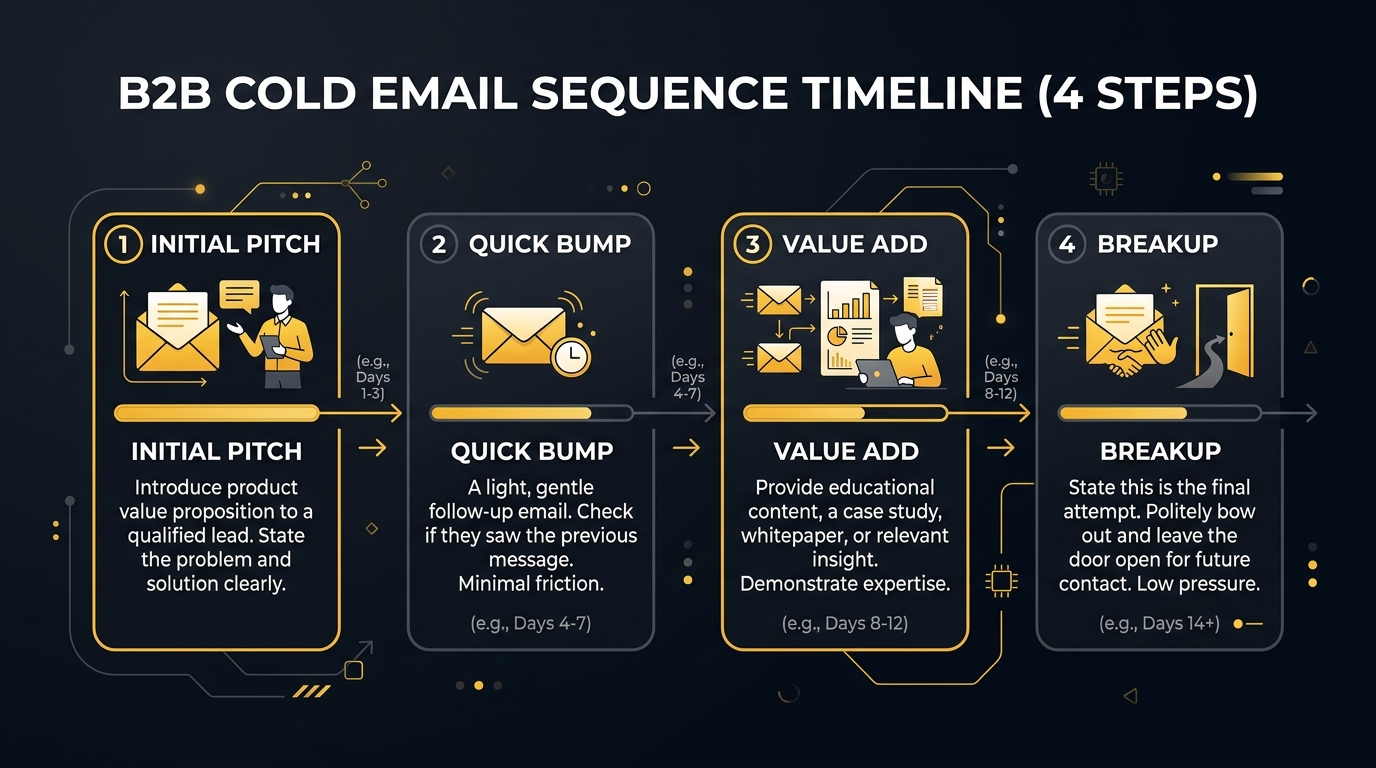
If you are searching for cold email follow-up best practices b2b saas law firm (or any other high-ticket B2B industry), this timeline is the gold standard. It gives the prospect breathing room between touches, while keeping your brand top-of-mind over a two-week period.
The Subject Line Dilemma: Threading vs New Threads
A massive debate in outbound sales revolves around the follow up email subject line.
When you send your Day 3 or Day 7 follow-up, should you reply to your own previous email (which keeps the same subject line but adds "Re:"), or should you start a brand new thread?
The "In-Thread" Strategy (Recommended) For your Day 3 and Day 7 emails, we highly recommend replying in the same thread. Do not overthink the subject line for follow-up email after no response—simply letting Gmail automatically append "Re:" to your original subject line provides context. The prospect can scroll down and see the original context of your pitch.
The "New Thread" Strategy (The Pattern Interrupt) By Day 14 (The Breakup email), the prospect has ignored your original thread three times. It is time for a pattern interrupt. Start a brand new email thread with a completely new follow up email subject line. Good examples include: "Closing the loop", "Should I stop reaching out?", or simply "Timing."
4 Sales Sequence Examples (The Templates)
When designing your sequence, every follow-up must serve a specific psychological purpose. Do not simply ask "Did you see my last email?"
Below are four sales email sequence examples and templates you can steal for your own campaigns.
1. The "Quick Bump" (Day 3)
The goal of the first cold email follow up template is simply to push the original message back to the top of their inbox. Keep it incredibly short. Do not restate your entire pitch.
The Template:
"Hi ,"
"I know things get buried quickly. Just wanted to float my previous note to the top of your inbox in case you missed it."
"Is this a priority for right now?"
Why it works: It is an incredibly polite follow up email. It takes them two seconds to read, and it requires a simple "yes" or "no" response.
2. The "Value Add" (Day 7)
If you are planning a cold email follow up after no response by Day 7, you need to change your angle entirely. This follow up email template provides value without asking for a meeting.
The Template:
"Hi ,"
"I figured you were swamped, so I won't ask for a call right now."
"We recently helped a similar company in your space achieve [Specific Result]. I put together a quick 1-pager on exactly how we did it. Would you be opposed to me sending it over for you to review when things slow down?"
Why it works: You are acknowledging their busy schedule (building empathy) and offering a relevant resource. The CTA is frictionless—you are simply asking for permission to send a document, not asking for 30 minutes of their time.
3. The "Permission" Route (Alternative Day 7)
Sometimes, the best sales follow up email template is one that asks for directions rather than a meeting.
The Template:
"Hi ,"
"I know how annoying it is to get bombarded with emails, so I want to be respectful of your time."
"If isn't focused on [solving XYZ problem] right now, just let me know and I won't reach out again. If you are, is there a better time next month to reconnect?"
Why it works: It hands the power back to the prospect. By explicitly stating you don't want to bombard them, you instantly disarm their defensive sales filters.
4. The "Breakup" (Day 14)
The Breakup email is often the highest-converting email in the entire sequence. It leverages loss aversion. You are officially walking away, which forces the prospect to make a final decision.
The Template:
"Hi ,"
"Usually, when I haven't heard back by now, it means you're perfectly happy with how you are currently handling [Pain Point], or it's just not a priority this quarter."
"I'll stop reaching out. If things change, feel free to keep my information on file."
"Best,"
Why it works: It removes all sales pressure. By actively pulling the offer away, prospects who were "on the fence" will suddenly reply with, "Wait, sorry, I've just been busy. Let's talk next week."
The Danger of Manual Follow-Ups
If you are sending 10 emails a week, you can manage your follow-ups manually in Gmail.
But if you are sending 500 emails a day, manual tracking is impossible. You will inevitably send a "Breakup" email to someone who already replied to you, making you look incompetent and instantly killing the deal.
You must automate this process.
Automating the Sequence with InvokeIQ
This is exactly why we built InvokeIQ. Instead of manually tracking who replied and who didn't, you simply load your leads, paste your follow up email template variants into the sequence builder, and set your timing (Day 3, Day 7, Day 14).
InvokeIQ handles the rest:
- Automated Pausing: If a prospect replies to the Day 1 email, InvokeIQ instantly halts the rest of the sequence for that specific contact.
- AI Spintax: To protect your deliverability, InvokeIQ uses native LLMs to slightly re-write your follow-ups for every single recipient, ensuring Google doesn't flag you for sending the exact same text 1,000 times.
- Inbox Rotation: The volume of your follow-ups is automatically distributed across dozens of connected inboxes to keep your sending volume safely under Google's limits.
Final Thoughts
Do not overcomplicate your strategy. Write a strong initial pitch. Wait three days. Send a quick bump. Wait four days. Send a valuable resource. Wait seven days. Walk away.
If you respect the prospect's inbox and provide frictionless CTAs, your reply rates will climb.
Want to put this exact sequence on autopilot? Start sending for free with InvokeIQ.
Tags
Get the weekly brief
Enjoyed this article?
One email per week with the best cold email strategies, templates, and deliverability tips.